Under the shadow of an internal crisis eating away at Washington’s foundations, Donald Trump is playing his last card: war with Iran. Ignoring warnings from his own military command and cornered by massive public discontent, the president is betting on an external conflict as the ultimate smokescreen. But in a scenario of systemic collapse, a war with Iran may well become the final nail in his political coffin.
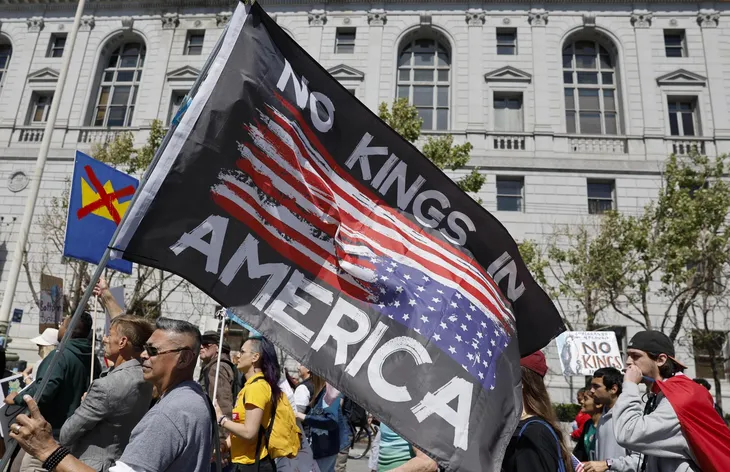
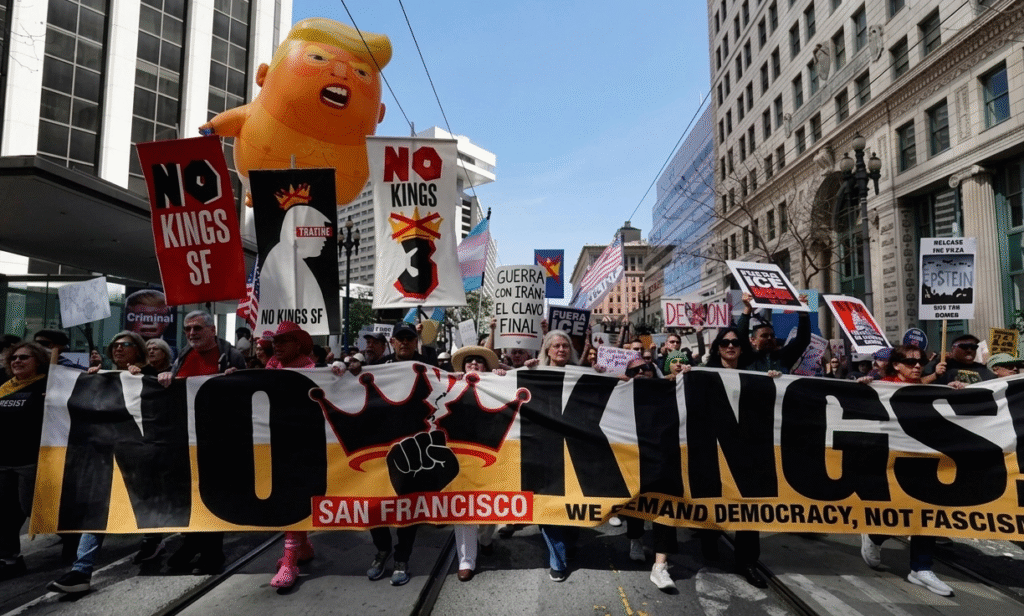
For months now, the United States has been experiencing a level of unrest not seen in decades. This is not an exaggeration — the numbers speak plainly. Under the slogan “No Kings,” millions took to the streets in April 2025 across 1,400 cities. Then, in June, the protests expanded to more than 3,000 cities under the “50501” movement (50 states, 50 protests, one movement). The message was clear: Americans voted for a president, not a monarch. And just last week, on March 25, 2026, the streets erupted again — millions more marching nationwide, with costumes, effigies, floats, and signs openly mocking Trump and demanding his resignation. This scale of anger has not been seen in years.
To find a comparable moment, one has to go back to the Vietnam War era, when mass demonstrations swept the country — driven not only by anti-war sentiment, but also by the civil rights struggle led by Martin Luther King Jr., Malcolm X, and James Baldwin, alongside the countercultural wave of the late 1960s. In that sense, today’s unrest is not accidental. It is the direct result of Trump himself.
When Trump came to power promising “no more wars,” he was explicit: we need to make America great again — bring back the money wasted on wars. For a population burdened by debt, precarious work, and a broken healthcare system, it sounded like hope. But that same population — one medical emergency away from financial ruin — was never meant to see the business behind war. And once Netanyahu convinced Trump — a man with little grasp of geopolitics — every pacifist promise collapsed overnight.
Much of the rapid push toward war, in my view, is tied to the scandals surrounding Trump and the Epstein files. That crisis demanded a distraction. Diversion is an old trick — used by magicians and politicians alike — and history offers precedents, such as Clinton’s bombing of Sudan during the Lewinsky scandal. The problem this time? The distraction meant confronting a historic enemy: Iran.
Under the pretext of uranium enrichment and nuclear ambitions, the alarms were raised and the attack was launched — based on the assumption that the Iranian population would turn against its own leadership. From a Western perspective, Iran is easily portrayed as a “rogue state,” defined by repression, lack of rights, and religious extremism. But for those who live there, it is a deeply rooted social and political reality, one that outsiders rarely understand. And then came the point of no return: the strike that killed Ayatollah Ali Khamenei.
Was this a catastrophic miscalculation by the most powerful military in history? It would be like Kasparov making a brilliant move — and then forgetting to press the clock. In reality, multiple voices had warned Trump directly: that confronting Iran would be a grave mistake, with consequences spiraling far beyond control — from the Strait of Hormuz to regional instability and the exposure of key allies.
Reports indicate that Trump dismissed intelligence assessments and clashed with senior military officials who warned of the risks. Following the initial strikes, several high-ranking officers resigned. Still, Trump pressed forward on what increasingly looks like a suicidal course — at least for his political future. Because in the end, the dead are always the same: ordinary people on both sides.
Sun Tzu, the greatest theorist of war, wrote: “There are armies that must not be fought, territories that must not be contested, and cities that must not be besieged.” Iran fits that definition perfectly: a country shielded by harsh geography, bound by a fusion of nationalism and religion, and positioned near strategic lifelines — from desalination infrastructure to undersea data cables — and above all, with the ability to choke the Strait of Hormuz at will.
And yet here is Trump, trying — needing — to project strength abroad after losing all authority at home. For many Americans, he is no longer a leader but a reckless figure, driven more by ego than strategy. Among world leaders, he is increasingly seen as something even worse: a powerful man acting without restraint, mistaking noise for influence.
“To stop a revolution, we need a small victorious war”
Those were the words of Vyacheslav von Plehve, Minister of the Interior under Tsar Nicholas II. The logic remains unchanged: when power erodes at home, war becomes a tool of survival. Margaret Thatcher understood this during the Malvinas War, just as Argentina’s military junta did. For both sides, the conflict was less about sovereignty than about recovering lost legitimacy. Britain won — and Thatcher was politically reborn.
Trump, politically weakened and internally isolated, believed this war would restore his standing. Instead, it may accelerate his collapse. The United States today shows signs of deep structural decay: immense wealth alongside mass poverty, failing public systems, addiction crises, and growing insecurity. Calling it a “failed state” may sound extreme — but the symptoms are increasingly difficult to ignore.
With little room left to maneuver, Trump continues to steer a drifting ship. Meanwhile, China follows a far older principle: when your enemy is making a mistake, do not interrupt him. Patience, in this case, may be the most effective strategy of all.
Trump may not realize it yet — but his epitaph is already being written.
And it is written in Persian.

Fernando Chinellato
Profesor de música y estudiante de Filosofía. Creador de La Redada Diario.